
Hannah Anthony

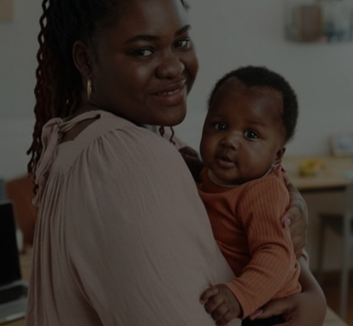
Image: An African woman, holding her baby at home.
Blessing Kalu, a Nigerian woman with a 2.1 in accounting and a mother of three, desired to build a corporate career and contribute meaningfully to her family’s finances, even if just little. Instead, she became a stay-at-home mom, caring for her newborn and two toddlers while struggling with the feeling that her academic qualifications were no longer useful.
“I felt inadequate,” she said. “I felt like maybe this was the end for me, like I had reached a dead end. I felt lost. I didn’t even know where to start.”
She once ran a small foodstuff business in Lagos but had to stop during a difficult third pregnancy, which forced her to step away completely. Since then, her husband has taken on the full financial responsibility of the home.
What The Economy Keeps Overlooking
Her story reflects a growing concern among many educated African women who step away from work due to childbirth or family responsibilities and struggle with reintegration into the workforce.
She is not an exception; across Africa, her story reflects the reality for many women. According to a report from the International Labour Organization, women with young children are less likely to be employed than men, with mothers of children under five recording employment rates of about 47.6 percent compared to 87.9 percent for fathers, a gap shaped largely by unpaid home-front work and reduced access to formal employment.
That economic exclusion also overlaps with a widening digital divide in Africa. As the digital economy is growing across Africa, access remains uneven. Data from the CFYE program shows that digitally enabled jobs accounted for nearly 62 percent of employment created or improved across its Africa portfolio, with 53 percent going to young women. However, mothers with young children remain largely overlooked in the workforce, despite being educated and motivated, as seen in Blessing’s case.
The Opportunity Surfaced
One afternoon, Blessing came across a fully funded scholarship in social media management while scrolling through her feed. She opened the link, completed the application form, and was later accepted into the program. For her, the funding mattered as much as her passion to succeed.
“At that time, I wouldn’t have been able to afford the full fee,” she said. “The scholarship made it easy.”
The program was run by the Digital Marketing Skill Institute, a women-focused digital skills initiative called the Digital Marketing Women Employability and Entrepreneurship Program (DM-WEEP), funded by the Challenge Fund for Youth Employment (CFYE), a Netherlands government-backed fund operating across 11 African countries.
She started the course while breastfeeding her baby. “I was actively nursing my son, my last baby, when I started the 2-month online training in social media management, from home,” she said. “But because I had this desire to leave my comfort zone, to do something meaningful, I had to push harder than my current surroundings or situation.”
A Career Path Into Global Opportunity

Image: Blessing on her laptop, working from home.
Blessing did not secure a paying client in the weeks after graduating. Instead, she worked unpaid on a friend’s social media platforms, gradually building a portfolio while trying to establish credibility in the digital marketing space. She later took a hybrid job in Lagos, but the demands of long commutes, combined with caring for three children, proved difficult to sustain.
“I wanted a job that would allow me to be present for my children,” she said, noting that this shaped her decision to pursue remote opportunities both locally and internationally.
“It took more than a year after completing the course before I landed my first international client,” she said. “At the time, I was earning $75 a week.”
The job showed that the digital skills were marketable beyond her immediate environment. It also challenged the assumption that geography limited opportunity. From that point, she began targeting international remote jobs more.
By the time of this interview, she was earning more than ₦500,000 a month, working with both local and international clients, and leading a small team while also training junior staff. The income, she said, had grown beyond what she once expected from a conventional office job. When asked to compare, she said, “It’s better, far better than before.”
She Is Not Alone, But the Gaps Remain.
DMSI has recorded outcomes among other women who benefited from the scholarship program. Aisha Alhassan, a nursing mother featured on the Women for Digital YouTube channel, completed her training while balancing childcare responsibilities and went on to secure a role with a real estate firm. Similarly, Eunice Wajira, a Kenyan beneficiary, landed three different roles with three top international companies, Ebere Agbaje, Raheedat Eleosho, and many more mothers.
These are the stories that get told, and they should be told.
Women Voice in a Male-Dominated Industry
Speaking about the women-focused initiative, the CEO of the Digital Marketing Skill Institute, Tobi Asehinde, said, “We are equipping women with practical digital marketing skills that translate directly into income through employment or business and helping more of them transition into visible roles within the digital economy.”
He added that the initiative is also addressing the gender gap within the industry by positioning more women for visible and competitive roles.
“We want to see more women not just participating, but leading and building in this space,” he said. “That is how long-term economic opportunities are created.”


